Discover OOPSI
OOPSI is a flexible and easy-to-use collaboration framework that product teams cut through complexity, focus on value and deliver with confidence. It breaks down complex problems into manageable chunks, supports alignment around outcomes and accelerates delivery.
While many frameworks focus on a single layer of delivery, OOPSI connects business outcomes directly to concrete examples and data, with shared understanding acting as the spine of the entire process. Whether you're exploring a large, complex initiative or refining an existing story, feature, enhancement or epic, the same five steps help teams validate scope and identify natural opportunities to break work into smaller, more manageable slices.
By making abstract ideas tangible through real-world examples and simple illustrations, OOPSI tackles one of the biggest challenges teams have faced for decades: balancing agility with rigour. It introduces just enough thinking and documentation at the right time, keeping clarity and discipline without the overhead of bloated specifications.
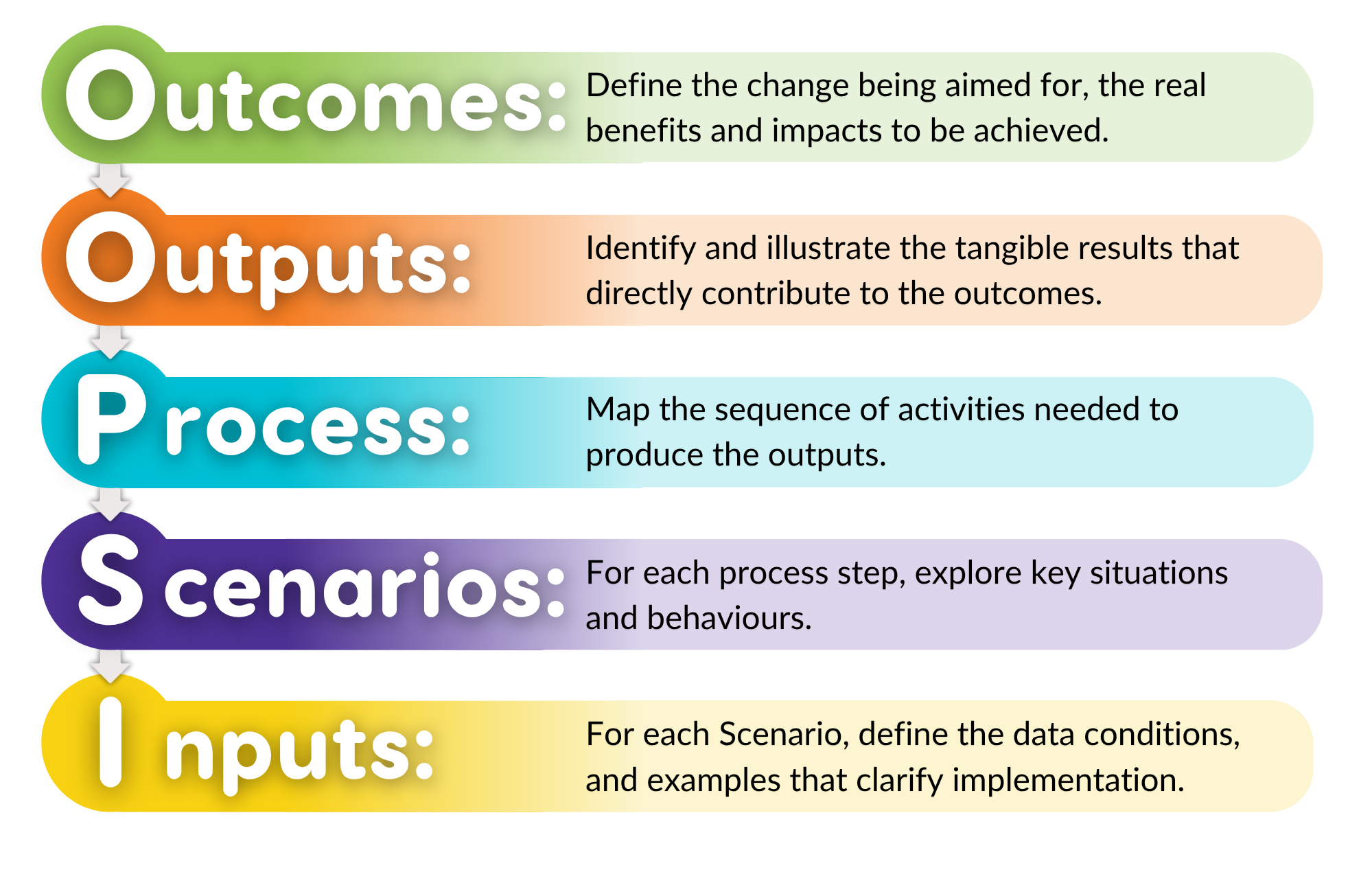
The framework follows a simple, repeatable sequence of five steps:
Why Now?
Despite decades of Agile adoption, many cross-functional teams still struggle to balance collaboration, discovery and delivery. While Agile encourages smaller increments of work, it often lacks the structured thinking required to align those increments with strategic goals. OOPSI helps teams bridge that gap without sacrificing agility.
The framework emerged from real-world delivery challenges and has quietly gained traction over the last decade. I have been both surprised and humbled to discover it being adopted by major organisations and consultancies, often entirely without my knowledge.
Its relevance is only increasing as AI and automation change the economics of software development. Generating code, tests, documentation and specifications is becoming faster and easier, but accelerating execution does not remove the need for shared understanding. If anything, it increases the urgency of aligning on intent, value and trade-offs before execution accelerates.
As delivery activities become increasingly automated, teams risk focusing too heavily on prompts, specifications and generated outputs without truly understanding the problem they are trying to solve. The challenge is no longer simply how to build software quickly. Increasingly, the challenge is how to build shared understanding quickly enough to deliver the right thing.

Addressing Agile Pain Points
Modern Agile and product practices were intended to improve collaboration, adaptability, and feedback. However, as adoption became widespread, the mechanics of Agile scaled faster than the actual human collaboration needed to support them. We adopted the ceremonies but missed the shared understanding.
Today, valuable conversations often get fragmented across tickets, tools, refinements, and handovers. What gets lost in the noise is the very thing that makes product development work: genuine shared understanding, fast feedback, and continuous learning.
If you've worked in Agile teams for any length of time, these situations will probably feel familiar.
User stories were originally intended to act as tokens for conversation. As Jeff Patton notes, "Stories get their name from how they should be used, not what should be written."
In practice, many teams treat the token itself as the deliverable. This subtle shift transforms refinement from an act of collective discovery into a siloed exercise in requirements writing. The result is Template Zombie Mode (focusing on syntax over substance), extreme backlog fragmentation, and an overwhelming wave of downstream rework. Instead of improving clarity, teams generate activity while gradually losing sight of the bigger picture.
User Story Hell

OOPSI helps by progressively breaking work into manageable chunks while keeping teams connected to the big picture, reducing cognitive load and helping them decide what to explore now and what to defer.
Many organisations adopted Agile delivery mechanics while leaving longstanding patterns of handovers and sequential governance intact. This creates the classic "Water-Scrum-Fall" cycle: waterfall analysis upfront, iterative development in the middle, and waterfall-style release testing at the end.
We see this clearly when Epics are treated as preconceived solutions waiting to be broken down, rather than big outcomes waiting to be explored. Even within a single sprint, the iteration can behave like a mini-waterfall, replacing cross-functional collaboration with sequential handoffs.
Water-Scrum-Fall
OOPSI helps by giving teams a shared structure for collaboration that clarifies when and how to collaborate, and by creating lightweight shared artefacts that build shared understanding and inform delivery.
Continuous delivery transformed how teams release software, reducing risk and enabling faster feedback. But an intense focus on keeping work flowing can unintentionally overshadow the early collaborative thinking needed for effective product development.
Teams can become highly optimised for delivery mechanics while spending too little time exploring outcomes, validating assumptions and working through concrete examples. Work flows efficiently through pipelines and boards, yet teams still struggle to deliver the right thing.
The ability to deliver software continuously is not the same as identifying and delivering the earliest valuable increment. The goal is not simply to move tickets efficiently through a workflow, but to learn quickly, reduce expensive misunderstandings and deliver value as early as possible
Continuous Delivery over Early Delivery
OOPSI helps by maintaining a radical focus on outcomes and hunting value, helping teams get started on something concrete while creating more opportunities for feedback and learning.
Outcomes are the cornerstone of OOPSI. They define the change you're trying to create in the real world and become the why behind everything that follows. Rather than jumping straight to features or solutions, OOPSI begins by asking what success actually looks like.
OOPSI doesn't prescribe how you explore or define outcomes. Whether you're using customer interviews, Design Thinking, Story Mapping, OKRs, Jobs to be Done, or another approach entirely, the important thing is to make the outcomes explicit and agree which ones matter most before moving into delivery.
Whether you're starting with a new initiative, an epic, a feature or an existing user story, the principle remains the same: identify and prioritise the highest-value outcomes before exploring unnecessary detail. This creates clarity, aligns the team around a shared purpose and helps keep the focus on meaningful change rather than predefined solutions.
Teams aligned around outcomes make better decisions.

Stepping Through OOPSI
If outcomes are the why, outputs are the what. They are the tangible things your system produces to create the change you're aiming for. They might be physical, like money dispensed from an ATM, or digital, such as a confirmation email, an updated balance or a completed booking.
Systems Thinking teaches us that the value of a system lies in its outputs. Illustrating those outputs changes the conversation. Instead of jumping straight into processes, user stories or technical solutions, teams first agree what valuable results need to exist. Using concrete examples, sketches or mock-ups surfaces hidden assumptions and creates a shared understanding of what success looks like.
Outputs create natural opportunities for prioritisation. By illustrating the results, teams can decide which outputs matter most, helping them start small, deliver value earlier and build confidence without losing sight of the bigger picture.
Making outputs explicit helps teams bridge the gap between product thinking and engineering, creating a shared understanding of what they're trying to deliver before deciding how to build it.

Process defines the steps needed to produce the prioritised outputs, providing the narrative and context that bring clarity to complex systems.
Because the outputs have already been prioritised, they tell a coherent story about the change you're trying to create. Collaborating around those outputs naturally narrows the scope of the process. Rather than mapping every possible path through the system, teams focus only on the steps needed to produce the agreed outputs. The process becomes linear, making it immediately clear not only what the team is working on, but just as importantly, what they're deliberately not exploring yet.
This creates natural opportunities for thin vertical slices. Teams deliver complete, end-to-end flows that generate meaningful value, while alternative paths, edge cases and additional complexity are introduced only when they're needed. The result is a clearer shared understanding, lower cognitive load and faster feedback.
By focusing on the process for the prioritised outputs, teams know what to do now, what can safely wait, and how to start small without losing sight of the bigger picture.



Scenarios describe the expected behaviours for each step in the process. By anchoring scenarios to individual process steps, OOPSI reduces the scope of each conversation, making behaviours easier to explore, organise and understand.
Starting from too high a level often leads to sprawling acceptance criteria, duplicated behaviours and living documentation that's difficult to navigate and maintain. Organising scenarios around individual process steps helps teams focus on the behaviours that matter now, while leaving lower-priority paths and edge cases until they're genuinely needed.
OOPSI also separates scenarios from the example data used to prove them. Behaviours are defined first; the specific inputs come later in the Inputs step. This keeps conversations focused, aligns naturally with practices such as Behaviour-Driven Development (BDD) and Specification by Example (SBE), and makes it easier to build clear, maintainable living documentation.
Organising scenarios around individual process steps helps teams explore behaviour systematically, reducing overwhelm living documentation.



Inputs are the specific preconditions, examples and real-world data needed to prove that a scenario behaves as expected. They transform expected behaviour into something concrete that can be explored, demonstrated and tested.
OOPSI doesn't prescribe how you capture examples. Whether you're using Specification by Example (SBE), Acceptance Test-Driven Development (ATDD), traditional test cases or spreadsheets, the important thing is to collaborate around examples in a way that makes the behaviour concrete and easy for everyone to understand. In approaches such as SBE and ATDD, these collaborative examples become both the specification and the basis for testing, creating a shared understanding long before development begins. The value of an example lies in the concrete, real-world data used to drive it. It is the detail within the data that sparks questions, reveals complexity and builds a shared understanding across the team.
Working with real-world data uncovers hidden assumptions, business rules and misunderstandings long before development begins. Because the earlier OOPSI steps have progressively narrowed the scope, teams can focus on a small, purposeful set of examples rather than trying to anticipate every possible data combination.
OOPSI provides a natural structure for integrating acceptance-test-driven practices into the broader iterative delivery flow. By giving outcomes, outputs, process, scenarios and examples a clear place within the framework, it creates living documentation that's easier to navigate and enables cross-functional teams to collaborate more effectively.


Applying OOPSI
If your starting point is a story, feature, enhancement or epic that's already been identified, you'll typically move through the five OOPSI elements once, progressing from Outcomes to Outputs, Process, Scenarios and Inputs. OOPSI in the Small helps teams build a shared understanding of what they're trying to achieve, what to build and how to get started with confidence.
OOPSI in the Small
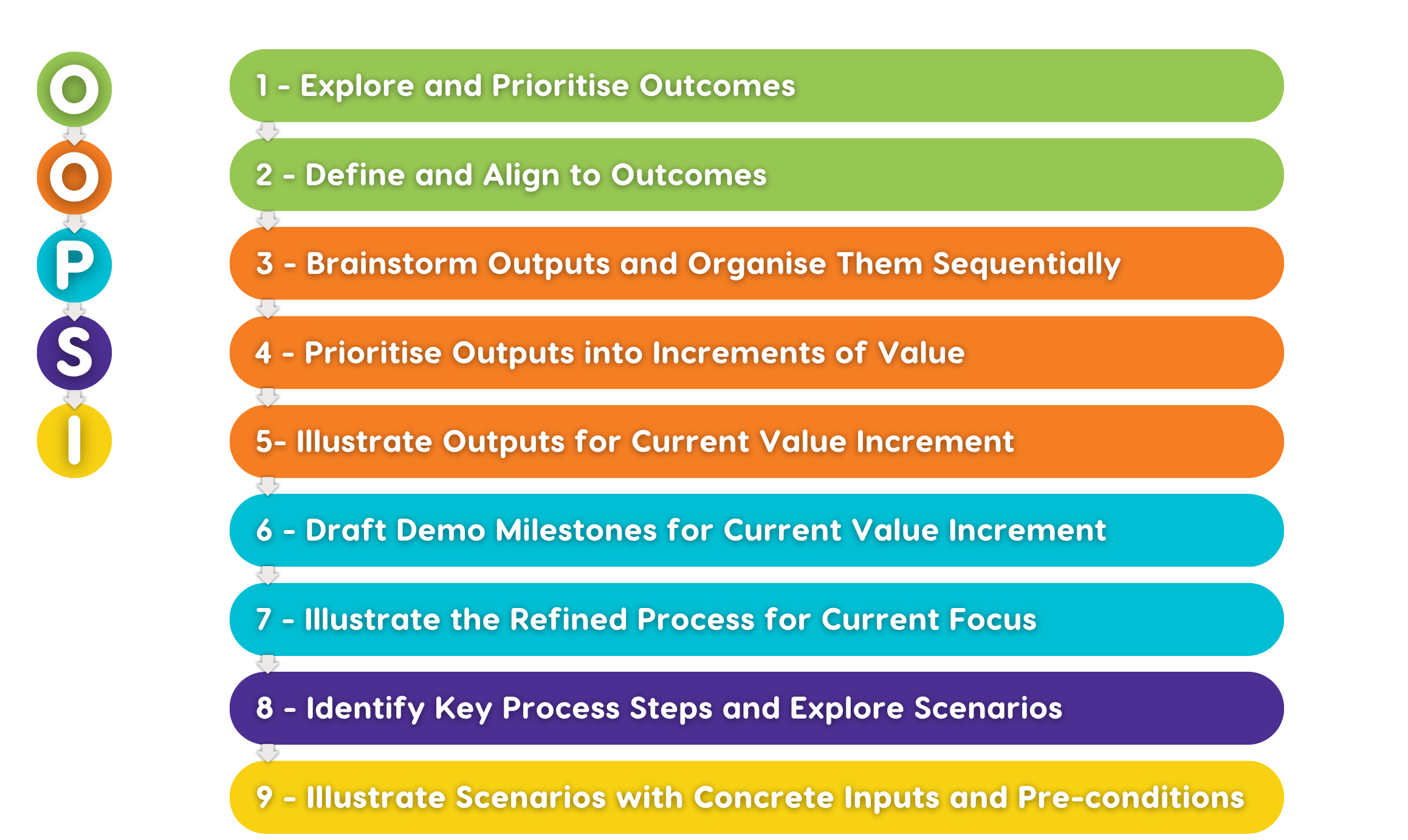
For larger initiatives, OOPSI is more like navigating to value. It provides additional structure to help teams explore, prioritise and progressively narrow the scope. Here you'll use the full set of nine Process Patterns (below) to break a large, uncertain challenge into manageable increments of value, identify where to begin, and continue delivering value incrementally.
OOPSI in the Large
The five OOPSI elements describe what teams collaborate around. The nine process patterns show how OOPSI in the Large is applied in practice, providing a collaborative pathway from discovery through to implementation. Each Process Pattern is explored in detail in the OOPSI book with worked examples and practical guidance. You'll also find the official Miro board, templates and additional examples on the Resources page to help you put OOPSI into practice
The Nine Process Patterns
OOPSI Underlying Principles
These five principles capture the philosophy behind OOPSI. They've been shaped by more than 25 years of experience, together with the ideas, practices and communities that have influenced my thinking along the way, including Lean, Agile, Agile analysis, product thinking, outcome-based planning and acceptance-test-driven development.
Over the years, I've found myself returning to these principles time and again, regardless of the methodology, framework or process I was using. OOPSI isn't intended to be another prescriptive methodology or rulebook. Too often, frameworks become disconnected from the thinking that made them valuable in the first place.
Rather than asking teams to follow these principles explicitly, OOPSI has been designed to naturally reinforce them through the way the framework is applied, helping teams adapt the framework to their own context while preserving its original intent.
Strip away the unnecessary to focus on the leanest most valuable slice of work that tells a coherent story and helps you learn.
Start Small
Collaborate, Collaborate, Collaborate
Unite diverse perspectives to dismantle silos, co-create richer solutions, and build deeper alignment and shared understanding.
Navigate to value - tenaciously pursue the 20% that delivers 80% of the impact, making sure you are always working on the most important thing.
Hunt the Value
Maximise opportunities for collaboration and build in continuous feedback loops to accelerate learning and make sure you’re heading in the right direction.
Optimise for Feedback and Learning
Illustrate concrete examples as a clear target for development, transforming abstract concepts into shared understanding, aligning perspectives, and building clarity.
Use Examples to Guide Conversations
Getting Started with OOPSI
You don't need a major transformation to start benefiting from OOPSI. Whether you're exploring a new initiative or refining an existing story, OOPSI is designed to fit alongside the way your team already works. Start small, experiment, and let the framework evolve with your team.
Shift to outcome-based conversations – Start by asking "What change are we trying to make?" before discussing features or user stories. Small changes in the way conversations are framed can have a surprisingly big impact.
Tune into your collaboration heartbeats – Every delivery system has natural rhythms for learning and feedback. OOPSI helps you recognise those moments and identify where a little more collaboration could create greater clarity and alignment.
Use OOPSI as a conversation starter – You don't have to announce "we're doing OOPSI." Take the pen and use the five elements to guide discussions, structure shared thinking and progressively build understanding together.
Build on your existing practices – OOPSI isn't about replacing what already works. It helps teams connect and strengthen the practices they already use, creating a more coherent flow from discovery through to delivery and testing.
Ready to go further?